
America’s Next Defense Frontier: Viruses, Vaccines, AI, and the Race to Prevent the Next Global Crisis
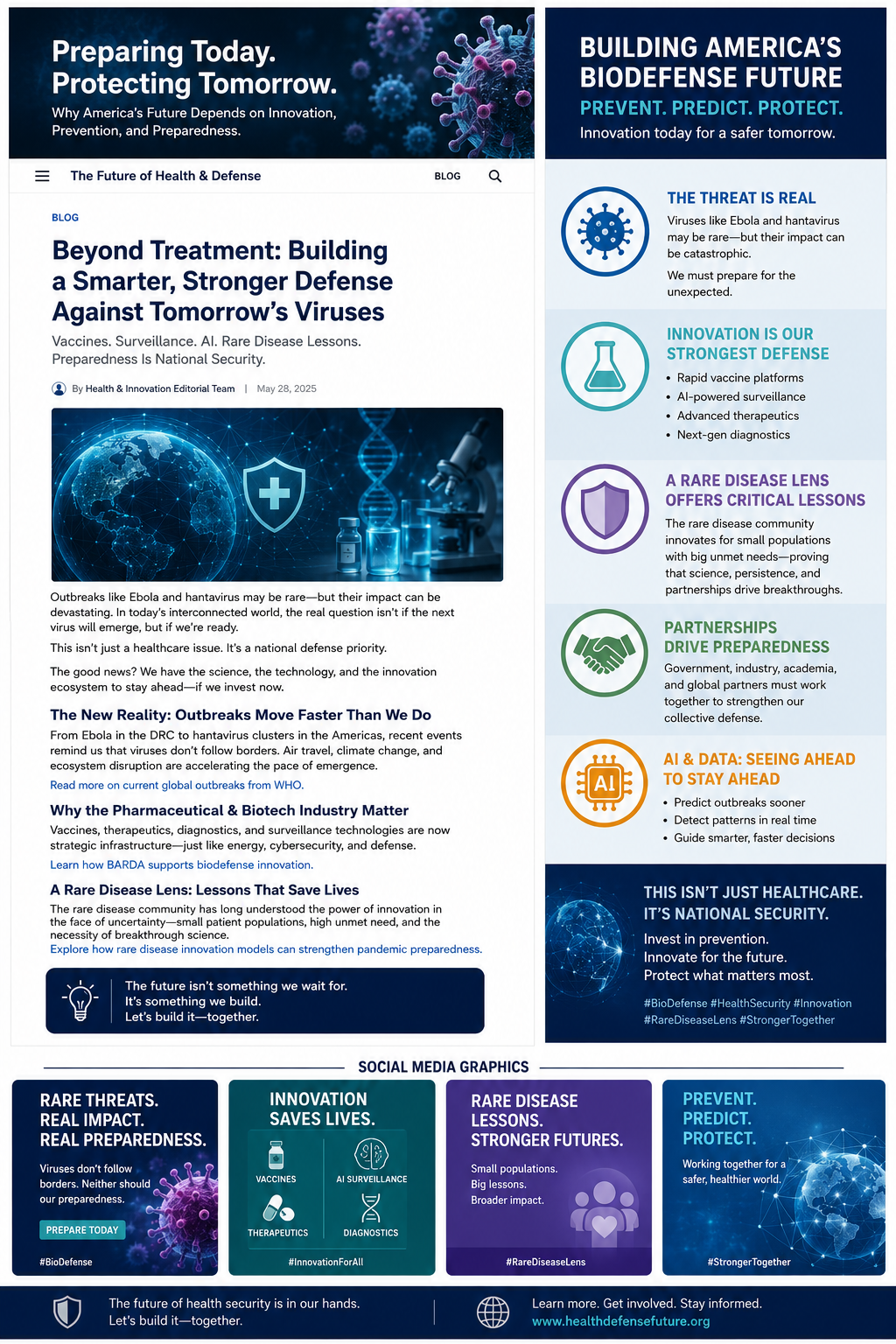
The world is once again being reminded that infectious disease is not merely a healthcare issue — it is a national defense issue, an economic issue, and increasingly, a technological arms race. From Ebola outbreaks to concerns surrounding hantavirus clusters, governments and industries are confronting the reality that biological threats can destabilize societies, supply chains, and economies.
The Pharmaceutical Industry as Strategic Infrastructure
Vaccines, antiviral therapies, biologics, genomic sequencing, and rapid-response manufacturing capabilities are now as strategically important as energy systems, cybersecurity, and military logistics. Organizations such as BARDA, CEPI, NIH, and the CDC play major roles in biodefense preparedness.
The Funding Challenge
Pharmaceutical companies often face uncertain returns when investing in vaccines for rare or unpredictable outbreaks. High regulatory costs, political funding cycles, and global supply-chain vulnerabilities discourage long-term preparedness investments.
The Role of Artificial Intelligence
Artificial intelligence can help analyze travel patterns, genomic mutations, environmental data, and hospital admissions to predict outbreaks before they escalate. AI-powered biosurveillance may become a cornerstone of future pandemic prevention.
Rapid Vaccine Platforms
The COVID-19 pandemic demonstrated how mRNA technologies can accelerate vaccine development. Future preparedness strategies require scalable, modular vaccine platforms capable of responding to emerging pathogens rapidly.
Biotech as a National Security Industry
Future biodefense capabilities may include AI-designed antivirals, wearable outbreak detection systems, wastewater genomic surveillance, CRISPR diagnostics, and autonomous laboratory systems.
Policy Recommendations
Governments could create permanent pandemic preparedness incentives including federal R&D grants, tax credits, guaranteed procurement contracts, and accelerated FDA review pathways to encourage pharmaceutical and biotech innovation.
The Commissioner’s National Priority Voucher Program is already an important step forward. The FDA launched the pilot to shorten review timelines for qualifying drugs and biologics aligned with U.S. national priorities, with the goal of reducing review time from about 10–12 months to 1–2 months.
This perspective is also informed by my prior work supporting the defense industrial base, where I advocated for stronger national-priority pathways to accelerate innovation in areas tied to health security, preparedness, and national defense.
For biodefense, this kind of national-priority review pathway matters because it begins to address one of the biggest gaps in preparedness: companies need clearer incentives to invest before an outbreak becomes a crisis. A strengthened National Priority Review model could help pharmaceutical and biotech companies move faster on vaccines, diagnostics, antivirals, and platform technologies tied to emerging infectious diseases.
The opportunity now is to build on this step forward with greater transparency, long-term funding alignment, and specific inclusion of rare and emerging pathogens. That would help smaller biotech firms, vaccine developers, and rare-disease innovators reduce the financial risk of preparing for low-frequency but high-impact threats.
Ultimately, the goal is not to weaken scientific standards, but to make the innovation pipeline more responsive to urgent national health needs.
The Rare-Disease Lens: Why Rare Viruses Need Rare-Disease Thinking
Rare diseases and rare viral outbreaks share the same strategic problem: the market often underinvests until patients are visible, urgency is undeniable, and the window for prevention has already narrowed.
The rare-disease model offers a useful parallel for Ebola, hantavirus, and other low-frequency, high-impact biological threats. A rare disease is commonly defined in the United States as affecting fewer than 200,000 people, yet rare diseases collectively affect more than 30 million Americans. This creates the same paradox seen in outbreak preparedness: each condition or pathogen may appear commercially small, but the combined public-health, economic, and national-security burden is enormous.
The Orphan Drug Act was created to correct market failure by giving sponsors incentives to develop products for small patient populations, including orphan designation, fee-related benefits, tax credits, grants, and potential market exclusivity after approval. A similar logic should guide biodefense. If society expects companies to prepare for rare viruses before demand exists, then policy must reduce uncertainty and reward readiness, not only sales volume after a crisis begins.
This does not mean copying the orphan-drug model without safeguards. Rare-disease policy also shows the importance of balancing incentives with affordability, evidence standards, transparency, and access. For biodefense, the goal should be a preparedness market: public-private contracts, advance purchase commitments, milestone prizes, subscription-style readiness payments, stockpiling agreements, and platform technology grants that pay companies to maintain capacity even when outbreaks are quiet.
The parallel also highlights why biotechnology and AI matter. Rare-disease research increasingly relies on genetic data, biomarker discovery, adaptive trial design, and patient registries. Outbreak preparedness needs comparable infrastructure: pathogen registries, genomic surveillance, wastewater monitoring, environmental biosensors, AI-assisted signal detection, and rapid clinical-trial networks that can activate before local outbreaks become global events.
What This Lens Adds to the Argument
Treat rare viruses as predictable categories of risk, even when specific outbreaks are unpredictable.
Use rare-disease incentives as a template for correcting market failure in vaccine, diagnostic, and antiviral development.
Fund platform technologies that can serve many pathogens rather than one disease at a time.
Build public trust by pairing incentives with access, affordability, transparency, and clear national-security accountability.
Conclusion
The next era of medicine will not be defined solely by hospitals and pharmaceuticals, but by prediction, prevention, and technological preparedness. Pandemic resilience must become a permanent component of national security strategy.
References & Embedded Source Links